
Decodo
The provider formerly known as Smartproxy — residential, ISP, datacenter and mobile pools alongside scraping APIs, and the clearest published documentation of rotation and authentication in this directory.
Visit decodo.com- Category
- Residential proxies and scraping APIs
- Protocols
- HTTP, HTTPS, SOCKS5
- Coverage
- 195+ locations (provider's figure)
- Targeting
- United States, United Kingdom, Germany, France, Canada, Japan, Australia
- Rotation
- Per request, or sticky for up to 30 minutes
- API
- Yes
- Pricing from
- $2 per GB, residential at volume
- Entry updated
- 2026-11-24
Formerly Smartproxy
Decodo is the same company that operated as Smartproxy; the rename took effect in April 2025 and the old domain still appears in the footer. If you are reading older comparisons, benchmarks or forum threads, they are describing this service under the previous name. That matters when evaluating third-party reviews, since a 2024 verdict on Smartproxy is a verdict on Decodo.
What Decodo sells
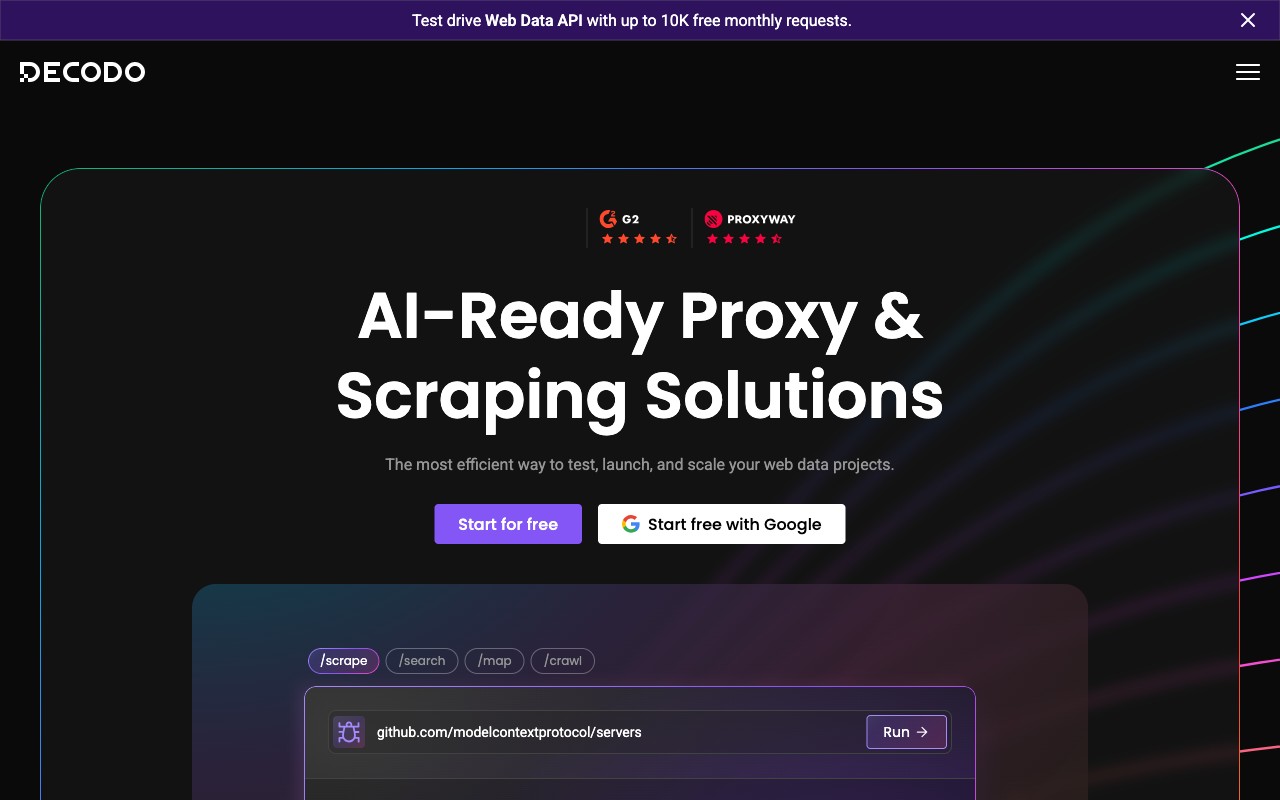
Six self-service lines: residential, ISP, mobile and datacenter proxies, plus Site Unblocker and a Web Data API exposing scrape, search, map and crawl endpoints. A seventh line, High-Speed Proxies, is quoted as price on request.
The split between raw proxies and finished scraping endpoints is the structural choice here. A proxy makes the request look different; an unblocker product takes responsibility for the request succeeding. The second is more expensive per unit and removes a category of work from your side. Decodo sells both and prices them separately, which makes the trade visible instead of bundled.
What it documents that others do not
Two facts are published here that most competitors leave unstated, and both are the ones that decide whether a provider fits a given workflow.
Rotation is specified. You can rotate the address per request, or hold one for up to 30 minutes. A stated ceiling on sticky duration is the single most useful number for anyone running multi-step sequences — a login followed by a cart followed by a checkout breaks if the address changes underneath it, and “sticky sessions supported” without a duration is not an answer.
Authentication is specified. Both username-and-password and IP whitelisting are offered. Credential authentication matters whenever your workers run on dynamic or ephemeral addresses, where whitelisting is impractical.
Protocols are also stated plainly: HTTP, HTTPS and SOCKS5, with output available as endpoint-and-port, HTTPS or SOCKS5.
Across the providers reviewed for this directory, Decodo is the only one whose own pages answer all three questions without a support conversation.
Network size and coverage
The homepage claims 125M+ IPs; the residential pricing page says 115M+. The two pages disagree, and neither explains the gap. Both figures are large enough that the difference is unlikely to affect a buying decision, but it is a reminder to treat pool sizes across this industry as marketing rather than measurement.
Coverage is stated as 195+ locations. Targeting is unusually granular: continent, country, state, city, ZIP code and ASN. ASN targeting for datacenter and ISP products is described as recently added.
Pricing
Residential is sold on declining per-gigabyte tiers, published in full:
- 3 GB — $3.75 per GB
- 10 GB — $3.50 per GB
- 25 GB — $3.25 per GB
- 50 GB — $3.00 per GB
- 100 GB — $2.75 per GB
- 250 GB — $2.50 per GB
- 1,000 GB — $2.00 per GB
The headline “From $2/GB” therefore describes the thousand-gigabyte tier, not the entry point. The practical entry price for a small buyer is $3.75 per GB on the 3 GB plan.
Other lines, as published: ISP from $0.27 per IP, datacenter from $0.02 per IP, mobile from $2.25 per GB, Site Unblocker from $0.95 per 1,000 requests, and the Web Data API from $0.15 per 1,000.
The datacenter rate is the striking one. At two cents per address, datacenter proxies are cheap enough that the deciding factor is almost never price but whether your target tolerates datacenter ranges at all.
Pay as you go, and its restrictions
Pay-as-you-go residential is $4 per GB — above every monthly tier, which is the expected premium for no commitment. Three restrictions apply and are easy to miss: it is wallet-only, it is bought one gigabyte at a time, and it cannot be combined with a monthly subscription. That last point rules out the common pattern of holding a small monthly plan and topping up during spikes.
Trials
Residential offers a 3-day free trial with 100 MB. The Web Data API has a free starter allocation of $5 in testing credits, up to 10,000 requests.
A conflict to note. The homepage footer advertises a 14-day free trial, which does not match the 3-day residential trial stated on the pricing page. They are probably describing different products, or the footer may be stale. Confirm which applies to the product you intend to test.
Self-service purchases carry a 14-day money-back window, conditions applying.
API and tooling
A single API key covers the Web Data API. Beyond the dashboard, Decodo publishes an MCP server, a CLI, and Python and TypeScript SDKs. The SDK coverage is more complete than most of this market offers and reduces the amount of glue code between a proxy purchase and a working pipeline.
Stated limits
The smallest residential monthly plan is 3 GB. The free trial is 100 MB. Pay-as-you-go is 1 GB per purchase. Concurrency limits are not stated on the pages reviewed.
Who it suits
Decodo suits buyers who want their questions answered before purchase rather than after. Documented rotation ceilings, both authentication methods, explicit protocol support and a fully published price ladder make it straightforward to evaluate on paper — which is not true of most of this market.
It suits less well anyone needing pay-as-you-go flexibility alongside a monthly plan, since the two cannot be combined, or anyone whose budget depends on the headline $2 rate without committing to a thousand gigabytes.
Disclosure. webproxylist.org is operated by the team behind ProxyVerity. This directory does not rank providers, and inclusion is not an endorsement — see About.
Pricing and coverage come from the provider and change without notice.