
IPRoyal
Multi-product proxy seller whose distinguishing feature is residential traffic that does not expire, sold usage-based with no contract.
Visit iproyal.com- Category
- Residential, ISP and datacenter proxies
- Protocols
- Not stated by the provider
- Coverage
- 60+ datacenter locations (provider's figure)
- Targeting
- United States, United Kingdom, Germany, Canada, Netherlands, India, Brazil
- Rotation
- Provider states unrestricted IP change control; mechanism not specified
- API
- Yes
- Pricing from
- $1.75 per GB, residential
- Entry updated
- 2026-11-24
What IPRoyal sells
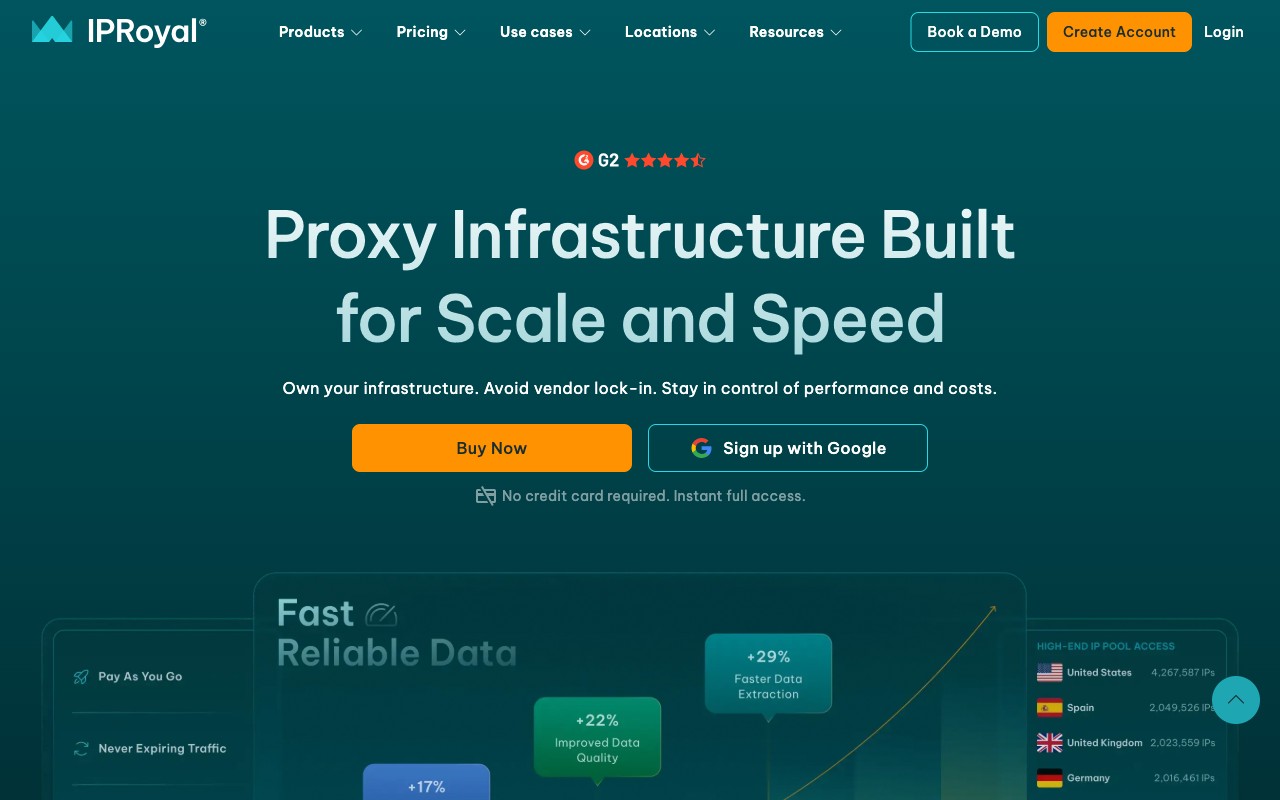
IPRoyal runs a broad product line: residential, ISP, datacenter and mobile proxies, plus a Web Unblocker product described as AI-driven. The residential pool is quoted at 64M+ addresses, ISP at 500K+ unique IPs, mobile at 4.5M+ IPs, and the datacenter product is described by footprint rather than count, at 60+ locations.
As with most multi-product sellers, the interesting question is not the headline pool size but which product you actually need. The four lines differ in how they are billed, and IPRoyal bills them differently on purpose: residential by the gigabyte, ISP and datacenter by the proxy, mobile by the month.
The thing that actually sets it apart: traffic that does not expire
Most residential proxy sellers bill you monthly for a bandwidth allowance that vanishes at the end of the billing period. Buy 50 GB, use 12, and the remaining 38 are gone. For workloads that are bursty — a quarterly price survey, an irregular compliance check, an occasional migration audit — this turns metered bandwidth into something closer to a subscription you underuse.
IPRoyal describes its residential traffic as non-expiring. That single property changes the arithmetic for intermittent work more than a difference of fifty cents per gigabyte would, and it is the first thing to weigh if your usage is uneven rather than steady. The company leans on it in its own positioning, alongside “transparent pricing” and “usage-based plans”.
The second claim it makes for itself is “Own your infrastructure. Avoid vendor lock-in.” — aimed at buyers wary of committing their pipeline to one provider’s proprietary endpoints.
Pricing
Published per-unit rates, no quote required for the self-service products:
- Residential: from $1.75 per GB
- ISP: from $1.80 per proxy
- Datacenter: from $1.39 per proxy
- Mobile: from $117 per month
- Web Unblocker: from $1.00 per 1,000 requests
The residential entry rate is at the low end for this market, and combined with non-expiring traffic it is a genuinely different commercial shape from the usual monthly allowance.
One figure to check. The pricing page gives mobile as $117 per month, while the homepage quotes $10.11 per day. Those do not reconcile cleanly — thirty days at the daily rate is over three hundred dollars — so they are presumably describing different plan structures. Confirm which applies before budgeting mobile.
ISP is explicitly described as pay-as-you-go, charging only for what is used. The residential pricing page states no contracts.
Coverage and targeting
Per-country address counts are published on the homepage rather than summarised — the United States figure is listed as 3,450,886. Targeting is offered at city and state level across residential, ISP and datacenter, which is broader than providers who restrict sub-country targeting to their residential pool only.
A total country count for the residential pool is not stated on the pages reviewed, and ASN targeting is not mentioned. If you need to target a specific carrier or hosting network, ask before buying rather than assuming it is available.
Protocols and authentication
Protocols are not stated on the pages reviewed. For a technical buyer this is a real gap: whether SOCKS5 is available alongside HTTP changes what you can route through the service, and it should not require a support ticket to establish. Treat it as a question to resolve before purchase rather than an omission to shrug at.
Authentication documentation is similarly thin. IP whitelisting appears under the security section, along with strict KYC and two-factor authentication on the account. Username-and-password proxy authentication is not stated.
The KYC requirement is worth flagging in both directions. It is friction at sign-up, and it is also a signal: providers who verify their customers tend to have fewer of the abuse problems that get address ranges blocked wholesale, which is ultimately your problem too.
Rotation
The pricing page says you can “control your IP changes with no restrictions” and the homepage mentions “smart rotation options”, but neither per-request rotation nor sticky session durations are specified. This is the single most important unstated fact across most of the providers in this directory, and IPRoyal is no exception. If your workflow depends on holding one address through a multi-step sequence — a login, a cart, a paginated result set — get the maximum sticky duration in writing.
API and account management
IPRoyal offers a REST API covering programmatic ordering and user management, not only proxy retrieval. The dashboard includes workspace controls, user roles and two-factor authentication, which points at teams and resellers rather than individual developers. Programmatic ordering in particular is uncommon at this price level and useful if you need to provision proxies as part of an automated pipeline rather than by hand.
Stated limits
The residential pricing page states no contracts. Mobile speeds are quoted as “reaching up to 100 Mbps” and overall uptime as 99.9%. Bandwidth caps, concurrency limits and minimum commitments are not stated on the pages reviewed.
Who it suits
IPRoyal fits buyers with uneven workloads who are penalised by expiring monthly allowances, and teams who need role-based account control or programmatic provisioning without moving to an enterprise contract. The low residential entry rate and the absence of a contract make it inexpensive to trial, though no free tier is advertised.
It is a weaker fit if you need documented protocol support or guaranteed session behaviour before committing, since neither is published. Resolve those two points first; everything else about the offer is unusually transparent.
Disclosure. webproxylist.org is operated by the team behind ProxyVerity. This directory does not rank providers, and inclusion is not an endorsement — see About.
Pricing and coverage come from the provider and change without notice.