
Webshare
Self-service datacenter, static ISP and rotating residential proxies with unusually granular plan sizing, published per-unit prices and a permanent free tier.
Visit webshare.io- Category
- Datacenter and residential proxies
- Protocols
- HTTP, SOCKS5
- Coverage
- 195 countries (provider's figure)
- Targeting
- United States, United Kingdom, Germany, France, Canada, Japan, Brazil
- Rotation
- Not stated by the provider
- API
- Yes
- Pricing from
- $2.99 per month, 100 datacenter proxies
- Entry updated
- 2026-11-24
What Webshare sells
Webshare runs three product lines rather than one pool with options. Proxy Server is its datacenter product, sold by the proxy rather than by the gigabyte. Static Residential is an ISP product, also sold per proxy, where the address stays the same between requests. Rotating Residential is the per-gigabyte residential pool. Both the datacenter and static residential lines are offered in shared, private and dedicated variants, which is the lever that moves price most on those products.
The split matters when comparing against providers who quote a single per-gigabyte rate, because two of Webshare’s three products are not priced that way at all. A fixed set of datacenter proxies at a flat monthly cost behaves very differently in a budget from metered residential bandwidth, and Webshare is one of the few providers that will sell either shape without a sales conversation.
Network size and coverage
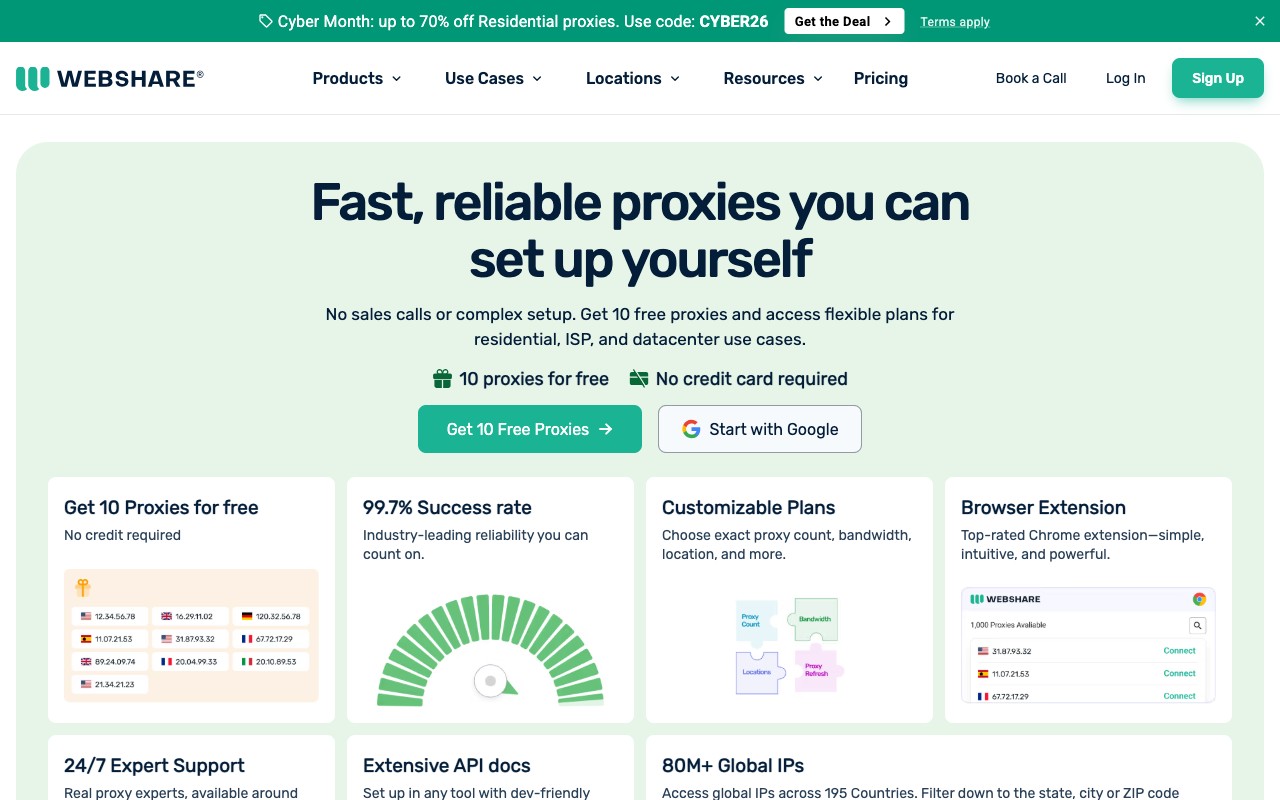
The company advertises 80M+ IPs across 195 countries for residential, and 400K+ addresses for the datacenter product. Per-country counts are published on the front page rather than hidden — the United States figure is listed as 6,652,539 addresses, which is the kind of number most providers round off or omit entirely.
One figure to treat carefully. The homepage says 195 countries, while the pricing page describes the Proxy Endpoints and Locations options as covering 50+ countries. These are almost certainly describing different products — the 195 belongs to the residential pool and the 50+ to datacenter endpoints — but the pages do not say so, and the two numbers sit close enough together to mislead. If geography is the deciding factor for your use case, confirm the list for the specific product you intend to buy rather than the headline figure.
Targeting
Webshare offers filtering by country, state, city and ZIP code. The rotating residential product adds ASN-level targeting on top of those, which is the control you want when the destination treats particular carriers or hosting networks differently. ZIP-level targeting is less common than city-level at this price point and is worth noting for anyone verifying locally-targeted advertising or regional storefronts.
Protocols and authentication
HTTP and SOCKS5 are both supported, stated on the pricing page under Proxy Endpoints and repeated in the free-plan documentation. SOCKS5 availability on the cheapest tier is not universal in this market, so it is worth registering.
Authentication is documented as IP authorisation: you whitelist the addresses that are allowed to use your proxies. Username-and-password authentication is not stated on the pages reviewed. That distinction matters operationally — IP whitelisting is awkward when your workers run on dynamic addresses or on ephemeral cloud instances, and if you need credential auth you should confirm it before committing.
Pricing
Webshare publishes per-unit prices rather than requiring a quote, which makes it one of the easier providers in this directory to budget against.
- Proxy Server (datacenter): from $2.99 per month for 100 proxies, which works out to roughly $0.0299 per proxy per month.
- Static Residential (ISP): from $6 per month for 20 proxies, around $0.30 per proxy.
- Rotating Residential: $3.50 per GB on a 1 GB plan, declining to $1.40 per GB at the 3,000 GB tier.
The company describes its own approach as “Most Customizable Pricing” and lets you choose proxy count, bandwidth and location independently rather than picking from fixed bundles. That is the genuine differentiator here: most competitors sell tiers, and Webshare sells dimensions.
A second figure to treat carefully. The homepage shows “$3.50/month” for Rotating Residential, while the documentation describes $3.50 as a per-gigabyte rate. Those are very different commitments. Read the plan builder before assuming the monthly reading.
The free plan
There is a permanent free tier: 10 proxies with 1 GB of monthly bandwidth, no credit card required. It is not a time-limited trial that expires into a paywall, which makes Webshare unusually practical for evaluating whether a proxy layer solves your problem before any spending decision. Plans can be changed mid-month, and cancelling is done by switching back down to the free plan rather than through a support request.
API and tooling
A documented REST API covers proxy management programmatically, alongside a dashboard with plan and usage statistics, a browser extension, and a published MCP server for driving the service from AI agent tooling. The MCP server is a recent addition across this market and its presence suggests the company is tracking agent-driven workloads rather than only classic scraping.
Limits worth knowing before you buy
Bandwidth on the Proxy Server and Static Residential plans is quoted as a range from 250 GB to unlimited, with “unlimited” explicitly subject to a fair usage policy — so it is not unlimited in the literal sense, and the ceiling is not published. Concurrency is quoted as 500 to 3,000 threads depending on plan.
Refunds are available only within two days of purchase and only below certain usage thresholds, which is tighter than the fourteen-day money-back windows some competitors offer. The free plan is capped at 1 GB per month. No minimum contract term beyond monthly billing is stated.
Who it suits
Webshare fits developers and small teams who want to buy a specific, modest quantity of proxies without talking to anyone, and who would rather read a price than request a quote. The free tier makes it a sensible first stop for testing. Teams that need credential-based authentication, a contractual bandwidth ceiling, or documented rotation behaviour should confirm those points directly, because the public pages do not cover them.
Rotation behaviour in particular is not described on the pages reviewed — neither per-request rotation nor sticky session durations are stated — and for residential work that is usually the first thing you need to know.
Disclosure. webproxylist.org is operated by the team behind ProxyVerity. This directory does not rank providers, and inclusion is not an endorsement — see About.
Pricing and coverage come from the provider and change without notice.